Claude Cahun transformed photography, writing, and performance into a fearless exploration of identity, becoming an artist whose courage still resonates today.
Claude Cahun
Claude Cahun was born Lucy Renée Mathilde Schwob on October 25, 1894, in Nantes, France. The child of a newspaper owner and a member of a culturally engaged family, Cahun grew up surrounded by literature, ideas, and artistic ambition. That environment helped shape a lifelong determination to question convention and create a life on personal terms.
In 1917, Cahun adopted the name Claude Cahun. The choice was deliberate. “Claude” could be used for any gender, while “Cahun” came from a family name. By choosing a gender-neutral identity, Cahun rejected the expectation that a person’s name, appearance, or social role had to follow fixed rules.
Cahun’s family included the Symbolist writer Marcel Schwob, an uncle whose literary world exposed the young artist to symbolism, experimentation, and intellectual freedom. This inheritance encouraged Cahun to see art not as decoration but as a way to examine truth, illusion, and the self.
From an early age, Claude Cahun explored photography, writing, theater, collage, and performance. Rather than choosing one medium, Cahun treated artistic practice as a continuum. A photograph could become a performance, a poem could become a visual object, and a self-portrait could become a philosophical question.
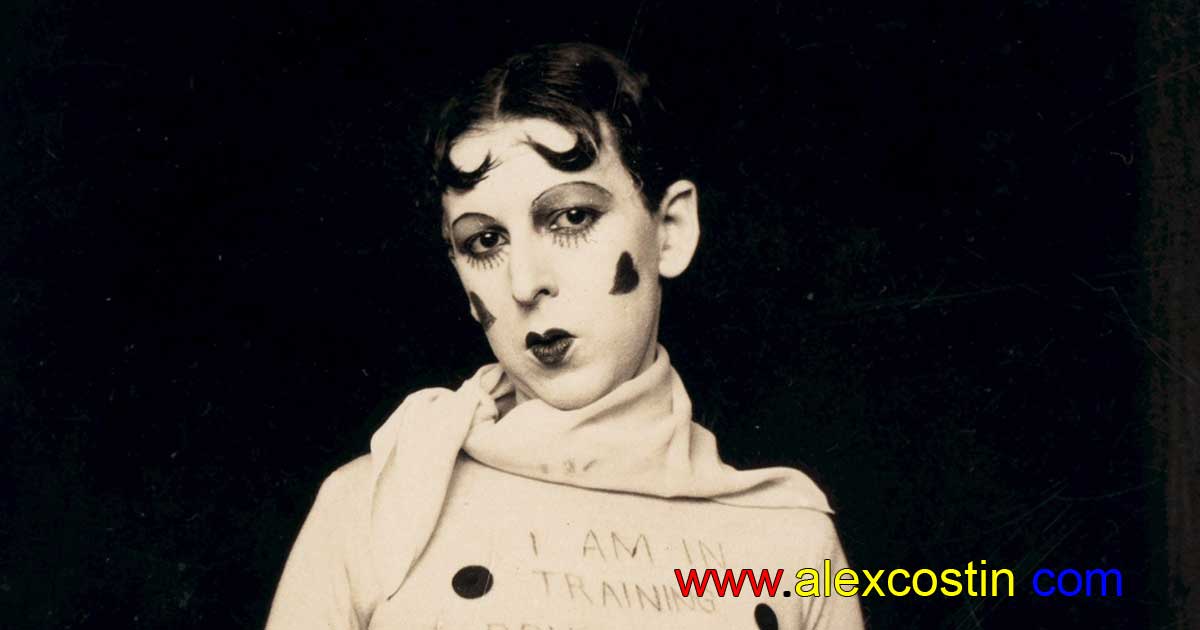
Cahun began creating staged self-portraits as a teenager and continued throughout life. These images often show the artist looking directly into the camera, wearing costumes, makeup, shaved heads, masks, or theatrical clothing. The photographs invite viewers to ask whether identity is something fixed or something continually performed.
Marcel Moore, born Suzanne Malherbe, became Cahun’s lifelong partner, collaborator, and creative ally. The two met as teenagers and remained together for decades. Moore often helped stage, photograph, and design Cahun’s visual work, while Cahun wrote, performed, and developed the conceptual foundation of their shared projects.
Their relationship was both personal and artistic. They lived together, worked together, and eventually resisted Nazi occupation together. Their partnership demonstrated how creative collaboration can become a source of strength, especially in a world that often refused to recognize their identities or their love.
Claude Cahun moved to Paris to study and became connected with the Surrealist movement. Cahun met André Breton and other leading figures, and Breton praised Cahun as one of the most curious spirits of the time. Yet Cahun never formally joined the Surrealist group, preferring artistic independence over affiliation.
That independence mattered. While Surrealism explored dreams, chance, and the unconscious, Cahun brought a distinctive focus on gender, self-representation, and political resistance. The result was an art practice that shared Surrealist methods but remained unmistakably personal.
In 1930, Cahun published Aveux non avenus, often translated as Disavowals or Cancelled Confessions. The book combined writing, aphorisms, photomontage, and visual experimentation. It challenged conventional autobiography by refusing to present a stable, complete, or easily categorized self.
Claude Cahun’s work asked radical questions for its time. What makes an identity authentic? Why should gender determine behavior, appearance, or social status? Can a person be many things at once? These questions remain urgent, which helps explain why Cahun’s art has gained such wide recognition in recent decades.
Cahun’s photographs frequently use mirrors, masks, shadows, and doubled images. These devices create uncertainty about what is real and what is constructed. Rather than offering a single answer, the work celebrates ambiguity as a form of freedom.
By the late 1930s, political danger was growing across Europe. Fascism, antisemitism, and authoritarianism threatened the values Cahun held dear. In 1937, Cahun and Moore moved to Jersey, a British Crown dependency in the English Channel, where they had previously spent time.
They settled at La Rocquaise, a house near St Brelade’s Bay. The island offered distance from mainland Europe, but it did not offer safety for long. In 1940, German forces occupied Jersey, placing the two artists directly under Nazi control.
Claude Cahun Surrealist Photography and Identity Art
Claude Cahun is now celebrated as one of the most original photographers of the twentieth century. The self-portraits for which Cahun is best known were not simple records of appearance. They were carefully constructed performances that questioned gender, beauty, authority, and the idea of a stable self.
In many images, Cahun appears bald, shaved, masked, costumed, or theatrically posed. Sometimes the artist appears masculine, feminine, androgynous, or deliberately difficult to classify. These visual choices challenged the rigid gender expectations of early twentieth-century Europe.
The photographs also challenge the viewer. Cahun often stares directly at the camera with an expression that is neither submissive nor easily readable. That gaze turns the portrait into a confrontation, asking the audience to reconsider its assumptions about identity and power.
Cahun’s use of photomontage expanded these ideas. By cutting, combining, and rearranging images, Cahun showed that reality could be assembled from fragments. The technique reflected a central belief: the self is not a fixed object but a complex construction shaped by memory, desire, society, and imagination.
Claude Cahun’s art was deeply collaborative. Moore’s role in staging and producing many photographs was essential, though historically it was often overlooked. Modern scholarship has increasingly recognized their partnership as one of the most important creative relationships in Surrealist and queer art history.
Their work anticipated later developments in performance art, feminist art, queer theory, and identity-based photography. Artists such as Cindy Sherman, Francesca Woodman, and Gillian Wearing have been linked to Cahun’s legacy because they also use self-portraiture to examine how identity is performed and perceived.
Cahun’s influence extends beyond galleries. Fashion designers, performers, writers, and activists have drawn inspiration from the artist’s refusal to be categorized. The idea that identity can be fluid, playful, and self-determined has become central to many contemporary cultural conversations.
Yet Cahun’s work was not only about personal freedom. It was also political. By challenging rigid norms, Cahun challenged the social structures that enforce them. Art became a way to resist conformity before the artist ever faced the direct danger of Nazi occupation.
That connection between art and resistance became even clearer during the war. Cahun believed that creativity could disrupt authority, undermine propaganda, and awaken people to the possibility of another future. The same imagination that shaped the self-portraits later shaped acts of defiance.
Cahun’s writing deserves equal attention. Essays, poems, and aphorisms explored the instability of identity and the power of language. Cahun used words not to explain away complexity but to preserve it, creating texts that remain challenging, poetic, and intellectually alive.
The combination of image and text is one reason Cahun’s work feels so contemporary. Today, artists routinely blend photography, performance, writing, and digital media. Cahun’s multidisciplinary practice anticipated that blending decades before it became widespread.
Claude Cahun’s achievement was to make uncertainty productive. Rather than treating ambiguity as confusion, Cahun presented it as a space for freedom. In that sense, the art remains not merely historical but actively useful for anyone thinking about identity, representation, and self-expression.
Resistance During the Nazi Occupation
When Germany occupied Jersey in 1940, Claude Cahun and Marcel Moore chose not to remain silent. They created a two-person resistance campaign, producing anti-Nazi leaflets and distributing them in places where German soldiers might find them.
The leaflets were written in German and designed to undermine morale. They mocked Nazi ideology, encouraged doubt among occupying troops, and used irony as a weapon. For two artists already skilled in performance, disguise, and visual communication, propaganda became another form of art.
Their resistance was dangerous. Jersey was under strict military control, and discovery could lead to imprisonment or death. Still, Cahun and Moore continued their activities for years, motivated by conscience and a refusal to accept fascism without challenge.
In July 1944, the Gestapo arrested them at their home. They were charged with listening to the BBC and inciting German soldiers to rebellion. The authorities treated them as dangerous opponents, even though their resistance network consisted primarily of the two of them.
Both were sentenced to death. The sentence was later commuted, but Cahun and Moore spent nearly a year in prison, often in separate cells. The experience damaged Cahun’s health and left lasting physical and emotional consequences.
Jersey was liberated in May 1945, and the two artists were freed. Their survival was extraordinary, but the ordeal changed them. Cahun’s health never fully recovered, and the artist died in St Helier, Jersey, on December 8, 1954, at the age of 60.
Their resistance demonstrates that courage does not always require armies or public recognition. Sometimes it takes the form of words placed where they might be found, ideas shared at great personal risk, and a refusal to cooperate with injustice.
Claude Cahun’s wartime actions also reveal the political depth of the art. The same person who questioned fixed identity through photography also questioned authoritarian power through resistance. For Cahun, freedom of self and freedom from oppression were connected.
Moore’s role was equally vital. Together, they proved that resistance could be intimate, creative, and deeply personal. Their story challenges the idea that historical heroism belongs only to soldiers, politicians, or leaders of large movements.
After the war, Cahun’s work was largely forgotten by mainstream art history for decades. Many photographs and negatives were lost or destroyed, and the artist’s gender identity and sexuality made it difficult for earlier institutions to understand the work fully.
That began to change in the 1980s, when Cahun’s photographs were reintroduced through exhibitions and scholarship. Since then, Claude Cahun has become recognized as a major figure in modern art, queer history, and the history of resistance.
The belated recognition is itself part of the legacy. It shows how artistic value can be obscured by prejudice, oversight, or the limits of an era’s categories. It also shows that forgotten artists can reenter history when new generations ask different questions.
Legacy and Cultural Influence
The legacy of Claude Cahun is profound because it joins art, identity, and moral courage. Cahun’s photographs, writings, and wartime resistance continue to inspire people who seek freedom from rigid labels and the courage to speak against injustice.
In art history, Cahun is now regarded as a pioneering figure of Surrealist photography and self-representation. The staged portraits anticipate contemporary debates about gender performance, authorship, and the constructed nature of identity.
In queer history, Cahun’s life is equally significant. By adopting a gender-neutral name, living openly with Moore, and creating art that challenged binary categories, Cahun offered an early and powerful example of self-definition.
The partnership with Marcel Moore also remains an important part of that legacy. Their shared artistic practice and wartime resistance show how love, loyalty, and collaboration can become forces of survival and defiance.
Claude Cahun’s influence can be seen in contemporary photography, performance, fashion, and activism. Artists continue to return to the self-portraits because they address questions that have not disappeared: Who gets to define identity? Who controls representation? What does it mean to resist being reduced to a category?
Cahun’s work also encourages viewers to embrace complexity. In a world that often demands simple labels, the artist’s photographs suggest that human beings are more layered than the categories imposed upon them. That message remains liberating.
The wartime story adds a moral dimension to the artistic achievement. Cahun did not merely create images about freedom; the artist risked life for it. This union of imagination and action gives the legacy unusual power.
Today, exhibitions, books, and public commemorations continue to bring Cahun’s story to wider audiences. A street in Paris honors Claude Cahun and Marcel Moore, while museums and scholars continue to reassess the importance of their work.
Claude Cahun’s life reminds us that art can be a form of resistance, identity can be a creative act, and courage can begin with the decision to be fully oneself. That is why the artist’s work continues to speak with urgency nearly a century after it was made.
Explore trusted resources, expert services, and local guides
Discover four handpicked destinations for SEO, English learning, orthopedic care, and Marbella travel