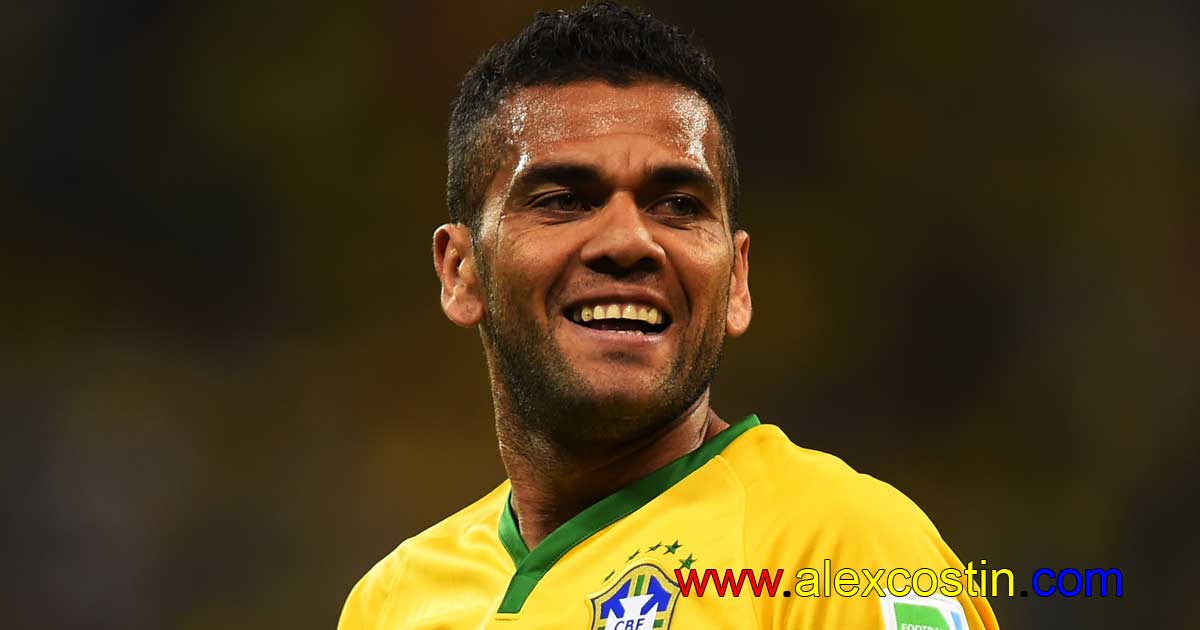
Dani Alves turned the right-back position into a stage for creativity, courage, and relentless ambition, becoming one of the most decorated footballers in history.
Dani Alves
Dani Alves was born Daniel Alves da Silva on May 6, 1983, in Juazeiro, a city in the state of Bahia, Brazil. Growing up in a modest family, he learned early that talent alone would not be enough. His journey from dusty local pitches to the biggest stadiums in Europe became a story of persistence, self-belief, and an almost defiant refusal to accept limits.
Football offered him more than a career; it offered a way to reimagine his future. As a boy, Dani Alves played with an energy that made him difficult to ignore. He was small in stature but large in personality, combining quick feet, sharp instincts, and a competitive fire that would later define his professional life.
His first major opportunity came with Bahia, one of Brazil’s traditional clubs. He joined the senior setup in 2001 and quickly showed that he could defend, attack, and influence matches from wide areas. Although he was still developing physically and tactically, his confidence on the ball marked him as a player with unusual potential.
In 2002, Dani Alves helped Bahia win the Copa do Nordeste, an early sign that his career would be built around winning. The trophy mattered, but so did the experience. It taught him how to handle pressure, how to compete against experienced opponents, and how to turn individual skill into collective success.
By 2003, Spanish club Sevilla had recognized his promise and brought him to Europe. The move was not simply a change of country; it was a test of adaptability. He had to learn a new language, adjust to a different football culture, and prove that a young Brazilian full-back could thrive in one of Europe’s most demanding leagues.
Sevilla became the place where his identity as an elite footballer truly began. Under coaches who valued intensity and tactical discipline, he developed into a complete wing-back. He could defend one-v-one, join attacks with timing and imagination, deliver dangerous crosses, and score important goals.
Dani Alves became central to one of the most successful periods in Sevilla’s history. The club won the UEFA Cup in 2006 and 2007, along with the UEFA Super Cup in 2006, establishing itself as a force in European competition. His performances showed that a defender could be both reliable and spectacular.
Those years also revealed his mentality. He played with visible emotion, celebrated every victory as if it were his first, and treated setbacks as fuel. That mindset would follow him throughout his career and help him succeed in dressing rooms filled with global superstars.
By the time Barcelona signed him in 2008, he was already regarded as one of the best right-backs in world football. The transfer represented a major step forward, but it also carried enormous expectations. Barcelona was assembling a team that would change the way football was played, and every player had to meet an exceptionally high standard.
Dani Alves Career Achievements and Major Trophies
Dani Alves spent eight hugely successful seasons at Barcelona from 2008 to 2016, becoming an essential part of one of the greatest club teams ever assembled. Alongside Lionel Messi, Xavi, Andrés Iniesta, Sergio Busquets, Gerard Piqué, and others, he helped define an era in which Barcelona combined technical beauty with relentless competitive excellence.
At Barcelona, he won six La Liga titles, four Copa del Rey trophies, three UEFA Champions League titles, three UEFA Super Cups, and three FIFA Club World Cups. Those achievements were not merely personal milestones; they reflected his ability to elevate the players around him and to perform on the sport’s biggest stages.
Dani Alves was especially important to Barcelona’s attacking structure. While many full-backs stayed wide and conservative, he moved inside, created overloads, linked with midfielders, and gave Messi space to drift inward. His understanding of space made Barcelona’s right side one of the most feared areas in world football.
The 2008–09 season was a breakthrough campaign. Barcelona won La Liga, the Copa del Rey, and the Champions League, completing a historic treble. Dani Alves contributed energy, width, and attacking threat throughout the season, helping the team transform possession football into a weapon of sustained dominance.
He repeated that European success in 2011 and 2015. In each Champions League-winning campaign, he showed different dimensions of his game: defensive concentration, intelligent positioning, precise passing, and the confidence to take responsibility in high-pressure moments. Few defenders have influenced so many decisive matches at the highest level.
His partnership with Messi deserves particular attention. Dani Alves often made runs that pulled defenders away, creating corridors for Messi to receive the ball and attack. In return, Messi’s presence created space for Alves to advance. Their connection became one of football’s most effective examples of mutual understanding.
After leaving Barcelona in 2016, he joined Juventus and immediately proved that his success was not dependent on one system or one group of teammates. In his single season in Turin, he won Serie A and the Coppa Italia, while helping Juventus reach the Champions League final.
Dani Alves then moved to Paris Saint-Germain, where he added two Ligue 1 titles, domestic cup honors, and further experience of competing at the top of European football. Even as he entered his mid-thirties, his fitness, technical quality, and tactical intelligence allowed him to remain a decisive player.
His return to Brazil with São Paulo in 2019 carried deep personal meaning. Playing in his home country allowed him to reconnect with supporters who had watched his rise from Bahia to global prominence. He helped São Paulo win the Campeonato Paulista in 2021, adding another trophy to an already extraordinary collection.
A second spell at Barcelona followed in 2021, when he returned at age 38 to support a young and rebuilding squad. Though the team was no longer the dominant force of his first era, his leadership remained valuable. He brought experience, standards, and a reminder of what the club had achieved during its greatest years.
He finished his club career with Pumas UNAM in Mexico in 2022 and 2023. By then, Dani Alves had played for major clubs across Brazil, Spain, Italy, France, and Mexico, adapting to different leagues while maintaining the same competitive hunger that had carried him from Juazeiro to the world stage.
Internationally, his record was equally impressive. He earned 126 caps for Brazil between 2006 and 2022, winning the Copa América in 2007 and 2019 and the FIFA Confederations Cup in 2009 and 2013. He also won an Olympic gold medal with Brazil at the Tokyo 2020 Games, held in 2021.
The 2019 Copa América was especially significant. As captain, Dani Alves led Brazil with maturity and passion, helping the national team win its first major trophy since 2007. His leadership showed that his value extended beyond goals and assists; he could unite a squad and set an example through daily commitment.
Across a 22-year professional career, he accumulated 43 major trophies, a total that places him among the most decorated players in football history. That number reflects longevity, versatility, and an unusual ability to remain relevant as tactics, teammates, and footballing demands changed around him.
His trophy cabinet tells only part of the story. Dani Alves also represented a new model for the full-back position: a player expected to defend, create, score, press, and act as an additional playmaker. His career helped expand what coaches believed a defender could contribute to a team.
He was not without controversy or criticism. His confident personality sometimes attracted attention, and his later legal case brought intense public scrutiny. In February 2024, a Barcelona court convicted him of sexual assault and sentenced him to four and a half years in prison. He spent 14 months in custody before being released on bail in March 2024.
In March 2025, Catalonia’s High Court overturned the conviction on appeal and acquitted him, citing evidentiary insufficiencies and inconsistencies in the case. The court also lifted the restrictions imposed after his release. The legal process remained subject to further appeal, making it a complex and deeply consequential chapter in his public life.
That episode cannot be separated from a complete account of his career, because public figures are judged not only by their achievements but also by the scrutiny that accompanies their influence. At the same time, his footballing record remains a major part of why he became such a prominent global figure.
Playing Style and Influence on Modern Full Backs
Dani Alves changed expectations for the modern right-back. Before his peak years, many full-backs were viewed primarily as defensive players whose main responsibility was to stop wingers and protect the penalty area. He helped popularize a broader role in which the full-back became a creative engine.
His technical ability was exceptional for a defender. He could control the ball under pressure, beat opponents in tight spaces, switch play with long passes, and combine quickly in small areas. Those skills allowed his teams to progress the ball through wide zones rather than relying only on central midfielders.
He was also a fearless attacker. Dani Alves made overlapping runs, cut inside to create passing angles, delivered crosses, and occasionally scored spectacular goals. His willingness to take risks gave his teams an extra dimension, particularly when opponents concentrated on stopping more famous attacking players.
Defensively, he combined aggression with anticipation. He enjoyed physical duels, read passing lanes well, and used his speed to recover after joining attacks. While his adventurous style occasionally created space behind him, his recovery pace and competitive instincts often allowed him to correct dangerous situations.
His stamina was another defining trait. Dani Alves could sprint up and down the flank for ninety minutes, repeatedly joining attacks and returning to defend. That physical intensity made him ideal for high-pressing teams, where full-backs must support attacks without abandoning defensive duties.
Perhaps most importantly, he understood football as a game of relationships. He knew when to overlap, when to stay wide, when to move infield, and when to let a teammate take the leading role. That tactical awareness made him valuable in different systems, from Barcelona’s possession game to Juventus’s more direct approach.
Young full-backs who grew up watching him learned that defending was only one part of the job. They saw a player who treated the flank as a creative corridor, someone who could influence possession, create chances, and change the rhythm of a match. His influence can be seen in the attacking responsibilities now given to full-backs worldwide.
He also embodied the value of reinvention. At Sevilla, he was a dynamic young wing-back. At Barcelona, he became a refined component of a possession-based system. At Juventus and Paris Saint-Germain, he adapted to new teammates and tactical demands. Later, in Brazil and Mexico, he used experience and leadership to remain effective.
That adaptability is a lesson for athletes in any sport. Talent may open the door, but sustained success requires the willingness to learn, adjust, and contribute in new ways. Dani Alves did not simply preserve his career through physical ability; he evolved his understanding of the game as his body and circumstances changed.
His personality also shaped his impact. He played with joy, expressed emotion openly, and brought a sense of theater to big occasions. Supporters often responded to that energy because it made football feel alive. He did not merely participate in matches; he tried to make them memorable.
At the same time, his confidence sometimes made him a polarizing figure. Strong personalities often are. Yet within teams, his competitiveness and high standards were widely recognized as valuable. He demanded intensity from himself and expected the same commitment from those around him.
His international career demonstrated another form of influence. Brazil has produced many legendary defenders, but Dani Alves brought a distinctly modern interpretation of the full-back role to the national team. He helped connect Brazil’s traditional attacking identity with the tactical demands of contemporary football.
Winning Olympic gold in 2021 was a fitting achievement for a player who had spent much of his career chasing team success. It also gave him a rare place among Brazilian footballers who had conquered both senior international tournaments and the Olympic Games.
By the end of his playing career, he had become a reference point for a generation of defenders. Coaches could point to his movement, passing, pressing, and decision-making when explaining what a complete modern full-back should be able to do.
Legacy Beyond the Pitch
The legacy of Dani Alves is complex because it combines extraordinary sporting achievement with public controversy and legal scrutiny. That complexity does not diminish the importance of his football career, but it does make his story more human, more difficult, and more instructive.
His rise from Juazeiro to Barcelona remains inspirational. It shows that opportunity can begin in unexpected places and that determination can carry a player beyond the boundaries of circumstance. For many young athletes in Brazil and around the world, his journey represents proof that ambition must be paired with discipline.
He leaves behind a footballing blueprint. The modern full-back is expected to defend, create, press, pass, and lead. Dani Alves did not invent every element of that role, but he performed it at a level that made the model impossible to ignore.
His 43 trophies also represent a standard of consistency. Winning once can depend on form, fortune, or a strong squad. Winning across different countries, competitions, and stages of a career requires resilience. It requires the ability to arrive in a new environment and quickly become indispensable.
His leadership offers another lesson. Dani Alves was not always the loudest tactical voice, but he led through energy, experience, and emotional investment. He understood that teams need players who can lift standards in training, calm nerves in difficult moments, and make teammates believe that success is possible.
For Barcelona supporters, he will be remembered as a key architect of an unforgettable era. For Sevilla fans, he remains part of the club’s European breakthrough. For Brazil, he is one of the most successful players the country has produced, with honors spanning the Copa América, Confederations Cup, and Olympics.
His story also carries a cautionary dimension. Fame magnifies both achievement and mistake. Public figures operate under intense observation, and their actions can affect communities far beyond the stadium. The attention surrounding his legal case showed how quickly a celebrated athlete’s reputation can become the subject of global debate.
Still, the sporting legacy endures. Dani Alves showed that a defender could be an artist, that a full-back could shape a team’s identity, and that success could be built through relentless work rather than inherited privilege. His career expanded the imagination of what footballers in his position could become.
In the end, his biography is not simply a list of medals. It is the story of a boy from Bahia who refused to be defined by limitations, became one of football’s most successful players, influenced a position for decades, and left behind a legacy that continues to provoke admiration, discussion, and reflection.
Explore trusted resources, expert services, and local guides
Discover four handpicked destinations for SEO, English learning, orthopedic care, and Marbella travel