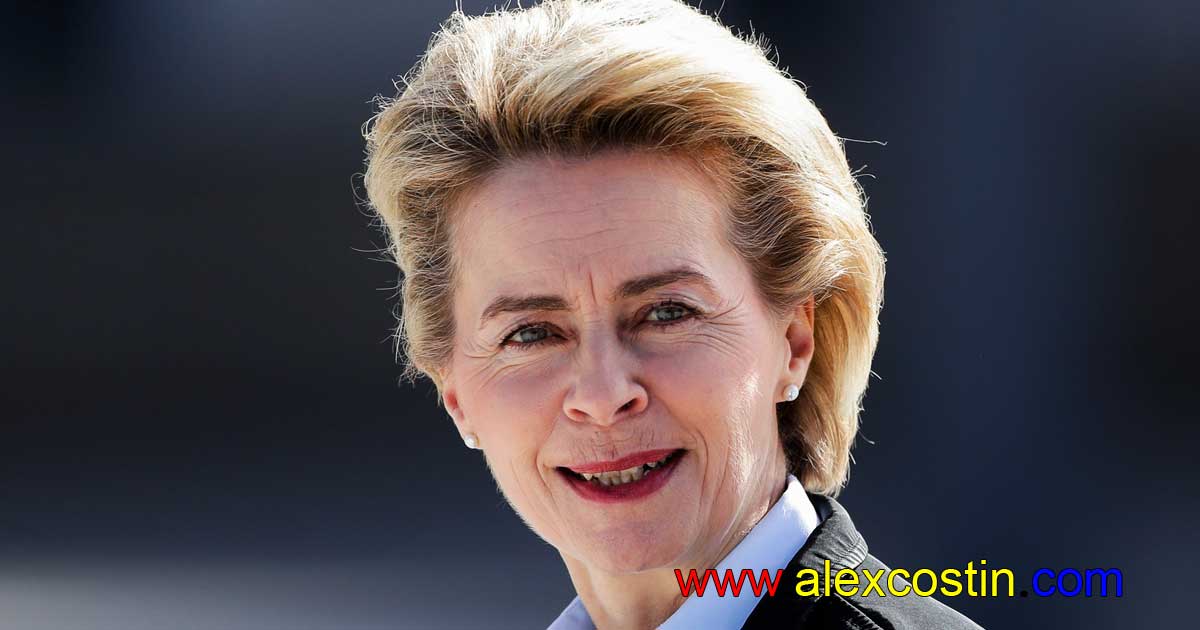
Ursula von der Leyen became the first woman to lead the European Commission, guiding Europe through pandemic, war, climate change, and profound geopolitical change.
Ursula von der Leyen
Ursula von der Leyen was born Ursula Gertrud Albrecht on October 8, 1958, in Ixelles, Brussels, Belgium. Her birthplace reflected her family’s deep connection to European institutions. Her father, Ernst Albrecht, worked at the Commission of the European Economic Community and later became minister-president of Lower Saxony in Germany.
Ursula von der Leyen grew up in an international environment. She attended the European School in Brussels from 1964 to 1971, where she learned several languages and developed an early familiarity with European cooperation. That background later influenced her conviction that European nations are stronger when they act together.
She initially studied economics at the University of Göttingen, the University of Münster, and the London School of Economics. Although she did not complete an economics degree, the experience broadened her understanding of public policy, markets, and international affairs.
She then turned to medicine, studying at Hannover Medical School. She received her medical license in 1987 and earned a Doctor of Medicine degree in 1991. Her scientific training gave her a practical, evidence-based approach that would later inform her work on health, social policy, and crisis management.
After completing her medical studies, von der Leyen worked as an assistant physician from 1988 to 1992. She later joined the academic staff at Hannover Medical School, focusing on epidemiology, social medicine, and health systems research. In 2001, she earned a master’s degree in public health.
Her entry into politics came through Germany’s Christian Democratic Union, or CDU, which she joined in 1990. She became active in Lower Saxony politics, the state where her father had served as a leading political figure. Her early career combined professional expertise with a growing commitment to public service.
In 2003, she was appointed Minister for Social Affairs, Women, Family Affairs, and Health in Lower Saxony. The position gave her direct experience with welfare policy, healthcare, and family support. It also established her as a rising figure within the CDU.
In 2005, Chancellor Angela Merkel appointed von der Leyen as Federal Minister for Family Affairs, Senior Citizens, Women, and Youth. She served in that role until 2009 and became known for expanding childcare provision and promoting policies that helped parents balance work and family life.
Her work on family policy was especially significant. Von der Leyen supported the expansion of childcare places, parental leave reforms, and greater opportunities for women in the workplace. These policies reflected her belief that economic opportunity and social equality must advance together.
From 2009 to 2013, she served as Federal Minister of Labour and Social Affairs. In that role, she focused on employment, pensions, social protection, and the challenges created by an aging population. Her experience in social policy strengthened her reputation as a practical reformer.
In December 2013, she became Germany’s first female Minister of Defence. The appointment was historic, but it also placed her in charge of one of the country’s most complex ministries. She oversaw the German armed forces, defense procurement, military reform, and Germany’s evolving international security role.
Her tenure as defense minister was demanding. She worked to modernize the Bundeswehr, improve equipment and readiness, and strengthen Germany’s commitment to NATO. She also faced criticism over procurement problems and military readiness, making the role a period of both achievement and intense scrutiny.
Despite those challenges, von der Leyen’s time at the Defense Ministry demonstrated her ability to lead in a traditionally male-dominated field. She became one of Germany’s most prominent female politicians and a possible successor to Angela Merkel within the CDU.
In 2019, European leaders nominated her to become President of the European Commission. The nomination was unexpected, but the European Parliament elected her on July 16, 2019. She took office on December 1, 2019, becoming the first woman to lead the European Commission.
Ursula von der Leyen European Commission Leadership and Achievements
Ursula von der Leyen’s first term as president of the European Commission began with an ambitious agenda. She presented six headline priorities: a European Green Deal, a Europe fit for the digital age, an economy that works for people, a stronger Europe in the world, promoting the European way of life, and a new push for European democracy.
The European Green Deal became the defining policy framework of her first term. It aimed to make Europe the first climate-neutral continent by 2050, reduce greenhouse-gas emissions, promote clean energy, and transform industry toward sustainable growth. The initiative placed climate policy at the center of the EU’s economic agenda.
Her Commission also pursued digital regulation and technological sovereignty. It worked on rules for artificial intelligence, online platforms, data protection, cybersecurity, and digital markets. These efforts reflected a growing recognition that technology shapes economic competition, democratic life, and individual rights.
The COVID-19 pandemic tested her leadership almost immediately. Von der Leyen coordinated the EU’s vaccine procurement strategy, helping member states secure vaccines collectively rather than competing against one another. The effort faced criticism over delays and supply problems, but it represented an unprecedented attempt at joint European action during a global emergency.
She also helped launch NextGenerationEU, a major recovery instrument designed to help member states rebuild after the pandemic. The program linked financial support to reforms and investments in sustainability, digital transformation, and resilience. It became one of the largest collective economic responses in EU history.
Russia’s full-scale invasion of Ukraine in February 2022 became another defining challenge. Von der Leyen led the Commission’s response, coordinating sanctions against Russia, supporting Ukraine financially, and helping Europe reduce its dependence on Russian energy.
Under her leadership, the EU provided major financial, humanitarian, and military-related support to Ukraine. She became a prominent international voice for Ukrainian sovereignty, repeatedly arguing that Europe’s security and values were directly connected to Ukraine’s ability to defend itself.
Her leadership during the Ukraine war strengthened her reputation as a decisive crisis manager. She traveled frequently, negotiated with world leaders, and presented the European Union as a geopolitical actor rather than only an economic bloc.
Energy security became a central priority after the invasion. Von der Leyen promoted plans to diversify gas supplies, accelerate renewable energy, improve energy efficiency, and reduce dependence on Russian fossil fuels. These policies connected climate goals with strategic security.
Her first term also advanced the EU’s role in global affairs. She emphasized partnerships with democratic allies, support for multilateral institutions, and a stronger European voice in trade, technology, and security. She argued that Europe must be capable of protecting its interests while defending international rules.
In July 2024, the European Parliament re-elected von der Leyen for a second five-year term as president of the European Commission. She received 401 votes in the Parliament, securing a new mandate for 2024 to 2029.
Her second Commission took office on December 1, 2024. Its priorities focused on prosperity, security, democracy, and global competitiveness. Von der Leyen emphasized the need for Europe to strengthen its economy, defend its values, and respond to a more unstable international environment.
Competitiveness became a central theme of her second term. She argued that Europe must improve innovation, reduce regulatory burdens where necessary, secure critical technologies, and strengthen industrial capacity. The goal was to ensure that Europe could compete economically while maintaining its social and environmental standards.
She also continued to prioritize support for Ukraine. In 2025, she announced plans to allocate 100 billion euros from the EU budget for Ukraine’s reconstruction, reinforcing the EU’s long-term commitment to the country’s recovery and European integration.
Von der Leyen’s leadership style combines technical expertise, political persistence, and a strong belief in European integration. She often presents the EU not as a distant bureaucracy but as a practical tool for solving problems that individual countries cannot solve alone.
European Green Deal and Global Crisis Response
The European Green Deal remains one of Ursula von der Leyen’s most consequential initiatives. It reframed climate action as both an environmental necessity and an economic opportunity, seeking to align emissions reduction with jobs, innovation, and industrial modernization.
The Green Deal set a target of climate neutrality by 2050. It also proposed a 55 percent reduction in greenhouse-gas emissions by 2030 compared with 1990 levels. These goals required major changes in energy, transport, agriculture, construction, and manufacturing.
Von der Leyen argued that Europe could lead the global clean-energy transition. She promoted investment in wind, solar, hydrogen, batteries, and grid infrastructure. She also supported policies designed to reduce dependence on imported fossil fuels and strengthen energy security.
The pandemic demonstrated the importance of European cooperation. By coordinating vaccine purchases and recovery funding, von der Leyen helped member states respond collectively to a crisis that no country could manage effectively alone.
NextGenerationEU became a landmark achievement of her first term. It provided large-scale financial support to member states while encouraging investments in digital infrastructure, clean energy, research, and social resilience. The program represented a significant step toward deeper European economic coordination.
The war in Ukraine further tested Europe’s unity. Von der Leyen helped coordinate successive sanctions packages against Russia and worked to ensure that Ukraine received sustained support. Her response positioned the EU as a central actor in defending European security.
She also emphasized the need to strengthen Europe’s defense capabilities. Von der Leyen argued that Europe must invest more in defense, improve cooperation among member states, and reduce strategic dependence on external powers. Her earlier experience as Germany’s defense minister gave weight to that agenda.
Technology policy became another major arena. Von der Leyen supported efforts to regulate artificial intelligence, protect personal data, strengthen cybersecurity, and promote European innovation. She argued that Europe should set global standards rather than simply follow technological developments elsewhere.
Her approach to global challenges combines idealism with pragmatism. She speaks about democracy, human rights, and international law, but she also emphasizes economic security, supply chains, energy independence, and military readiness.
That combination has made her a prominent figure on the world stage. She has represented the European Union in negotiations with the United States, China, the United Kingdom, Ukraine, and other global partners, often advocating for a stronger and more united Europe.
Her leadership has not been without criticism. Some argue that EU climate policies place too much pressure on industry, while others believe they do not move quickly enough. Her vaccine strategy, migration policy, and handling of internal EU politics have also drawn debate.
Those criticisms are part of any major political legacy. Leading a union of diverse member states requires balancing competing interests, and von der Leyen’s tenure has shown both the possibilities and the limits of collective European action.
Legacy and Influence on Europe’s Future
The legacy of Ursula von der Leyen is still unfolding, but she has already secured a historic place as the first woman to serve as president of the European Commission. Her leadership has reshaped expectations about Europe’s role in global affairs.
She inherited a European Union facing Brexit, climate change, digital transformation, and rising geopolitical tension. She then guided it through a pandemic and the largest war in Europe since World War II. Those crises tested the EU’s institutions and forced rapid adaptation.
Her greatest achievement may be her effort to make the European Union more strategic. Under her leadership, the EU moved beyond being primarily a single market and regulatory body to becoming a more active geopolitical actor.
The Green Deal gave Europe a long-term vision for sustainability. It linked environmental responsibility to economic renewal and positioned the EU as a global leader in climate policy. Its long-term success will depend on implementation, political consensus, and the ability to maintain public support.
Her response to COVID-19 showed both the strength and difficulty of collective action. The EU’s joint vaccine procurement and recovery fund were unprecedented, even though the process revealed weaknesses in coordination and communication.
Her response to Russia’s invasion of Ukraine demonstrated a clearer sense of purpose. Von der Leyen helped unify EU institutions around support for Ukraine, sanctions against Russia, and a long-term strategy for European energy and security.
Her second term focuses on making Europe more competitive, secure, and resilient. She has argued that Europe must invest in innovation, defense, clean technology, and strategic industries while protecting democratic values and social cohesion.
As a woman who has led major national and European institutions, von der Leyen has also become a symbol of female leadership in politics. Her career shows that women can lead in fields traditionally dominated by men, including defense, diplomacy, and executive government.
Her story is also a lesson in reinvention. She moved from medicine to public health, from national politics to European leadership, and from social policy to defense and geopolitics. Each transition required learning, adaptability, and courage.
Ursula von der Leyen’s influence will continue through the policies, institutions, and relationships she has helped shape. Whether Europe becomes more united, competitive, secure, and sustainable will depend on many leaders, but her presidency has helped define the direction of that effort.
Her biography is ultimately a story of public service at a time of extraordinary challenge. It shows that leadership requires not only vision but also persistence, cooperation, and the willingness to act when history demands it.
Explore trusted resources, expert services, and local guides
Discover four handpicked destinations for SEO, English learning, orthopedic care, and Marbella travel